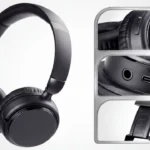

If you want a simple pair of wired headphones without paying for Bluetooth, batteries, apps, or unnecessary extras, the Sony MDR-ZX110 takes a straightforward approach.
These headphones combine a lightweight design, 30 mm dynamic drivers, a standard 3.5 mm connection, folding/swiveling earcups, and a compact build designed to make them easy to carry. They are particularly suited to people who want inexpensive headphones for everyday listening, travel, school, work, or casual entertainment.

Sony MDR-ZX110 Review: Are These Budget Wired Headphones Worth Buying?
A practical Sony MDR-ZX110 review covering sound, comfort, portability, build quality, wired connectivity, specifications, and who these budget headphones are best suited for.
But low cost always involves compromises. The MDR-ZX110 doesn’t offer wireless connectivity, active noise cancellation, a detachable cable, or the premium construction found on more expensive headphones. Independent reviews have also noted limitations in sound detail and long-session comfort.
So, are the Sony MDR-ZX110 worth considering?
For the right listener, yes—but they’re best understood as simple budget headphones rather than an all-purpose premium audio solution.
What are the Sony MDR-ZX110?
The MDR-ZX110 is a wired headphone from Sony’s ZX Series. It uses 30 mm dynamic dome drivers and connects to compatible devices through a 3.5 mm stereo mini plug.
Sony lists a 12 Hz–22 kHz frequency response, 24-ohm impedance, a 1.2-meter Y-shaped cable, and a lightweight 120-gram design. The earcups can swivel to make the headphones easier to store and carry.
There is no battery to charge and no Bluetooth pairing process. You simply connect the cable to a compatible headphone jack and start listening.
That simplicity is one of the product’s biggest advantages.
Sony MDR-ZX110 key specifications
| Feature | Sony MDR-ZX110 |
|---|---|
| Connection | Wired |
| Plug | 3.5 mm L-shaped stereo mini plug |
| Driver | 30 mm dynamic dome |
| Impedance | 24 ohms |
| Frequency response | 12 Hz–22,000 Hz |
| Cable length | 1.2 m / approximately 3.94 ft |
| Cable type | Y-shaped |
| Weight | Approximately 120 g |
| Design | Closed-back |
| Folding/swiveling earcups | Yes |
| Active noise cancellation | No |
| Battery required | No |
Sony’s published specifications confirm the core hardware details above.
Sound quality: what should you expect?
The MDR-ZX110 is designed around a relatively energetic presentation rather than an audiophile-oriented listening experience.
Independent testing has found that the headphones can produce a full, bass-forward sound that works particularly well for music where punch and low-end energy matter. One detailed review found the low end to be a strength while noting that upper-range detail and openness were less impressive.
That’s an important distinction.
The MDR-ZX110 can be enjoyable for everyday listening, but its specifications should not be interpreted as proof that it will reproduce every part of the audible spectrum equally well. A wide published frequency range does not automatically mean that a headphone has perfectly balanced or highly detailed sound.
What are they good for?
The MDR-ZX110 makes the most sense for casual listening such as:
- Music streaming
- YouTube
- Podcasts
- Audiobooks
- Videos and movies
- Everyday computer use
- Travel
- General listening at home
If your priority is highly detailed, neutral sound for critical listening, mixing, or serious audiophile use, you should look at more specialized headphones.
Comfort and fit
One of the most appealing characteristics of the MDR-ZX110 is its low weight. Sony lists the headphones at about 120 grams without the cord, which makes them considerably lighter than many larger headphones.
The cushioned ear pads and adjustable headband are intended to make everyday listening more comfortable.
However, comfort is personal, and independent reviews have reported that the fit can become less comfortable during extended listening. Because the earcups place pressure around the ear area rather than behaving like large, deeply padded premium headphones, some users may prefer them for shorter or medium-length sessions.
Our takeaway: the lightweight design is a genuine advantage, but don’t assume that lightweight automatically means comfortable for everyone for many hours.
Portability is one of the strongest features
If you travel with headphones, the MDR-ZX110 has a practical advantage: the earcups swivel, allowing the headphones to take up less space when stored.
The wired design also means there is no battery that can run out while you’re travelling.
The 1.2-meter cable gives you reasonable freedom when connected to a laptop or another nearby device, while the L-shaped 3.5 mm plug is designed for standard wired audio connections.
For a student carrying headphones in a backpack or someone who wants a simple travel pair, this combination of low weight and compact storage makes sense.
Build quality: where the budget shows
The MDR-ZX110’s inexpensive construction is one of the areas where expectations should remain realistic.
Independent reviews have criticized the predominantly plastic construction and raised concerns about durability compared with more substantial headphones.
That doesn’t mean the headphones are automatically fragile. It means they should be treated as an affordable everyday accessory rather than a premium piece of hardware.
If you regularly throw headphones into an overloaded bag, bend the headband aggressively, or need equipment for heavy professional use, a sturdier model may be a better long-term choice.
Wired connection: simple, but increasingly less universal
The MDR-ZX110 uses a conventional 3.5 mm wired connection.
That’s excellent if your laptop, tablet, phone, music player, or other device has a compatible headphone jack. There’s no Bluetooth pairing, charging, firmware, or wireless battery to worry about.
However, many modern smartphones no longer include a 3.5 mm headphone jack.
In that situation, you may need an appropriate USB-C or Lightning audio adapter, depending on the device.
This is worth checking before purchasing.
Does the Sony MDR-ZX110 have a microphone?
The standard MDR-ZX110 does not include a microphone or inline remote.
Sony specifically distinguishes the standard MDR-ZX110 from the MDR-ZX110AP, which is the related version that adds an inline remote and microphone for compatible smartphones.
That’s an easy detail to overlook when shopping because the model names are very similar.
If you need headphones for phone calls, verify the exact model before ordering.
Does the MDR-ZX110 have noise cancellation?
No. The standard MDR-ZX110 does not have active noise cancellation.
Its closed-back construction can help contain sound and provide some passive isolation, but that is different from active noise cancellation. Sony confirms that the standard model does not have ANC.
If you frequently travel on airplanes, trains, or noisy public transport and specifically want strong noise reduction, you should look at headphones designed around ANC instead.
Pros and cons
Pros
- Lightweight design
- Simple plug-and-play wired connection
- 30 mm dynamic drivers
- Compact swiveling/folding design
- No battery or charging required
- Standard 3.5 mm connection
- Closed-back construction
- Bass-forward, energetic presentation can suit casual music listening
- Sony’s established audio brand
Cons
- No Bluetooth
- No active noise cancellation
- No microphone on the standard MDR-ZX110
- Cable is not detachable
- Build quality is basic
- Long listening sessions may not suit everyone
- Sound detail is limited compared with more capable headphones
Who should buy the Sony MDR-ZX110?
The MDR-ZX110 is worth considering if you want simple, inexpensive wired headphones for everyday listening.
They’re particularly appealing if you:
- Prefer wired headphones
- Don’t want to worry about charging
- Need something lightweight for travel
- Mainly listen to music, podcasts, or videos casually
- Have a device with a 3.5 mm headphone jack
- Want a compact pair that can be stored easily
- Prefer spending less on headphones
Who should look elsewhere?
You may want a different model if you:
- Need Bluetooth
- Want active noise cancellation
- Need a built-in microphone
- Spend several hours a day wearing headphones
- Want premium materials and stronger construction
- Need a detachable cable
- Expect highly detailed or neutral sound for critical listening
Sony MDR-ZX110 vs. modern budget headphones
One of the biggest questions to ask before buying an older wired model like the MDR-ZX110 is whether you actually need a wired headphone.
Today’s budget headphone market includes wireless models with Bluetooth, long battery life, microphones, companion apps, and sometimes active noise cancellation. Current budget-headphone roundups also include wireless models with substantially more features than traditional entry-level wired headphones.
That doesn’t make the MDR-ZX110 obsolete.
It simply means its value proposition is different.
You’re primarily paying for basic wired listening, low weight, portability, and simplicity rather than a large feature set.
For someone who wants those specific qualities, fewer features can actually be an advantage.
Final verdict
The Sony MDR-ZX110 is a straightforward budget headphone that focuses on the basics.
Its lightweight construction, compact swiveling earcups, standard wired connection, and energetic sound make it a practical option for casual listening and travel. Sony’s published specifications also make the product’s hardware easy to understand: 30 mm dynamic drivers, 24-ohm impedance, a 1.2-meter cable, and a 12 Hz–22 kHz stated frequency response.
At the same time, buyers should have realistic expectations. This isn’t a premium headphone, and independent reviews have identified compromises in build quality, comfort for extended use, and sound detail.
The bottom line: if you want an affordable, lightweight wired headphone for everyday music, videos, podcasts, or travel, the MDR-ZX110 is worth considering. If you want wireless freedom, ANC, a microphone, premium comfort, or more refined audio performance, spending more on a newer model may make more sense.
Before buying, check the exact model number and your device’s connection options—particularly if you need a microphone or your phone doesn’t have a 3.5 mm headphone jack.