
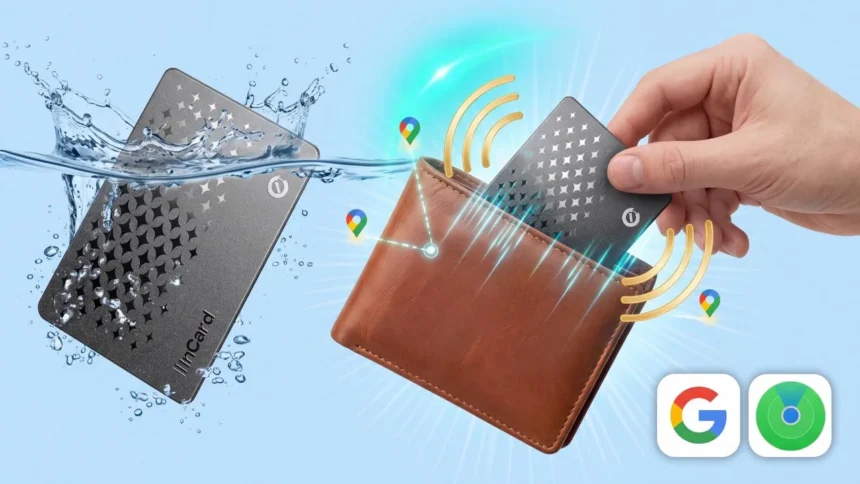
Losing a wallet is frustrating, but the bigger problem is often figuring out where you left it in the first place. A wallet tracker can solve that problem without adding much bulk—but only if it is thin enough to live comfortably inside your wallet and reliable enough to remain useful when your wallet is actually missing.
Wallet Tracker Card 0.06in Slim Tracking Card
Wallet Tracker Card 0.06in Slim Tracking Card,10 Years Battery Bluetooth Smart Card,Android & iOS Wallet Tracker,Work with Apple Find My & Google Find Hub,IP68 GPS Tracker for Vehicles,Wallet,Keys
The KIUP Incard Wallet Tracker Card takes an interesting approach. Instead of using a traditional round tracker, it uses a credit-card-style design measuring a claimed 0.06 inches thick. It connects through Bluetooth and is designed to work with both Apple Find My and Google Find Hub, giving it broader platform compatibility than many ecosystem-specific trackers. The manufacturer also claims up to 10 years of battery life, an IP68 rating, a loud 120 dB speaker, and UWB-based distance visualization.
But there is an important distinction before you buy: despite the Amazon title describing it as a “GPS Tracker,” the available specifications identify Bluetooth as its connectivity technology. It is better understood as a Bluetooth item tracker that uses Apple’s and Google’s finding networks—not as a standalone GPS tracker with its own cellular or GPS connection.
So, is the KIUP Incard a practical way to keep track of a wallet, keys, luggage, or other valuables? Let’s take a closer look.
What Is the KIUP Incard?
The KIUP Incard is a slim Bluetooth tracking card designed primarily for items that are difficult to attach to conventional key-fob-style trackers.
Its card-shaped design is particularly useful for wallets, passport holders, luggage pockets, backpacks, and other flat spaces. According to the product specifications available for the exact ASIN B0GCNMR68T, the card is identified as the KIUP Incard and uses Bluetooth connectivity, with Apple Find My and Google Find Hub listed as supported platforms.
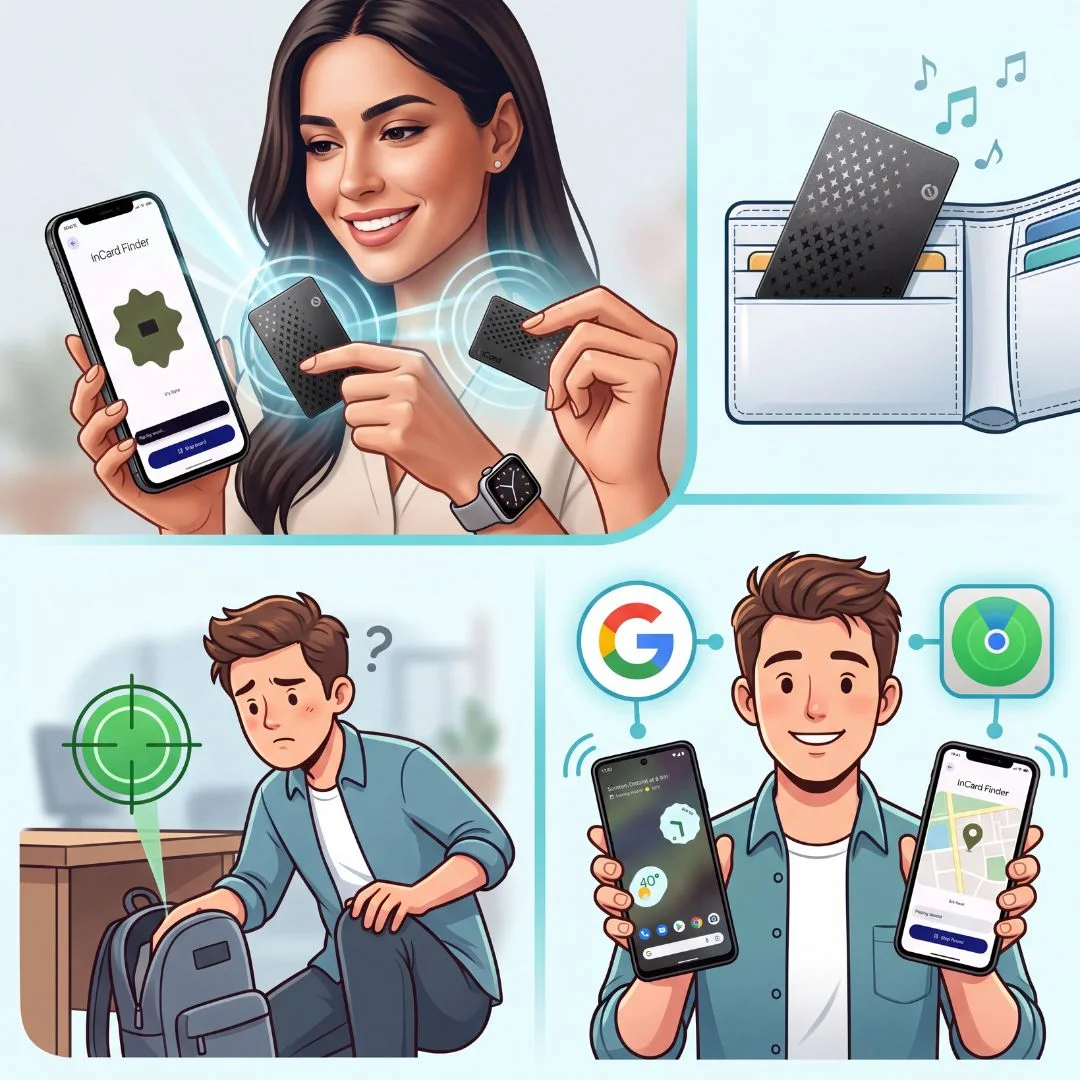
The basic idea is straightforward: pair the tracker with your compatible phone, place it inside the item you want to protect, and use the appropriate finding network when the item goes missing.
Apple allows compatible third-party items to be registered directly through the Find My app, while Google’s Find Hub supports compatible Bluetooth tracker tags for locating items such as keys, luggage, and other valuables.
That makes the Incard particularly interesting for households where people use different phone platforms.
Specifications
| Feature | KIUP Incard |
|---|---|
| Product type | Bluetooth tracking card |
| Model | Incard |
| Brand | KIUP |
| Listed thickness | 0.06 inches |
| Connectivity | Bluetooth |
| Apple compatibility | Apple Find My |
| Android compatibility | Google Find Hub |
| Battery claim | Up to 5–10 years / approximately 10 years |
| Battery capacity listed by retailers | 220 mAh |
| Speaker | Up to 120 dB claimed |
| Water resistance | IP68 claimed |
| UWB | Distance visualization claimed |
| Compatible Android version | Android 9 and newer, according to listing |
| Third-party app | Not required according to listing |
| Main uses | Wallets, keys, luggage, backpacks and similar items |
The specifications above should be viewed carefully because several details are manufacturer or retailer-listed claims rather than independently verified measurements. In particular, battery longevity, speaker output, UWB behavior, and waterproof performance can depend on how the product is used and on the capabilities of the paired phone.
The Biggest Advantage: Its Extremely Thin Design
The standout feature is the card format.
The product is advertised at just 0.06 inches thick, which is roughly 1.5 mm. That is dramatically slimmer than many traditional item trackers and makes the concept much more appropriate for a wallet.
This matters because a tracker can technically be useful while still being annoying to carry. A bulky device can take up valuable wallet space, create a noticeable bump, or make a minimalist wallet uncomfortable.
A thin tracking card avoids much of that problem.
For a traditional wallet, cardholder, passport sleeve, or luggage compartment, the flat shape is naturally convenient. The available product listings consistently identify the Incard as an ultra-thin 0.06-inch card.
If your main reason for buying a tracker is protecting a wallet, this design makes considerably more sense than a conventional keychain-shaped tracker.
Apple Find My and Google Find Hub Compatibility
Cross-platform compatibility is another major selling point.
The KIUP Incard is advertised as working with both Apple’s Find My and Google’s Find Hub. That means iPhone and Android users can potentially use the same style of tracker rather than buying an Apple-only or Android-only model.
On Apple devices, compatible third-party items can be added through the Find My app and associated with an Apple Account. Apple specifically supports third-party products that have been designed for the Find My network.
On Android, Google says compatible Bluetooth tracker tags can be used with Find Hub, including for objects such as keys, luggage, bikes, and other physical items. Google also explains that the broader Find Hub network can use participating Android devices to help locate offline items.
This network-based approach is important because the tracker itself does not need to have a cellular connection to appear on a map.
Is It Actually a GPS Tracker?
This is where the product’s marketing deserves some clarification.
The Amazon title describes the Incard as an “IP68 GPS Tracker,” but the specifications for the exact product identify its connectivity technology as Bluetooth.
That means you should not buy this expecting the same functionality as a dedicated cellular GPS tracker.
A traditional GPS vehicle tracker can contain GPS positioning hardware and cellular connectivity, allowing it to report its own location over a mobile network. A Bluetooth item tracker works differently.
With a compatible Apple or Google ecosystem, the tracker can be detected by nearby devices, and the network can use those detections to help determine where the item was last found. Google’s documentation describes Find Hub’s crowdsourced network as using nearby Android devices to help locate compatible tracker tags.
That makes this type of tracker excellent for things such as:
- Wallets
- Keys
- Backpacks
- Luggage
- Passport holders
- Personal belongings
But it should not be treated as a replacement for a dedicated cellular GPS vehicle-tracking system.
What About the 10-Year Battery?
The battery claim is one of the most unusual features of this tracker.
The product is advertised with up to 5–10 years of battery life, while retailer specifications list an average battery life of approximately 10 years and a 220 mAh battery capacity.
If the real-world lifespan approaches the advertised figure, that would be a major convenience advantage because you would not have to think about regular charging.
However, “up to 10 years” should not be interpreted as a guaranteed operating period under every condition.
Battery life depends on how the device communicates, how frequently it is located, environmental conditions, and other usage factors. There is also limited independent long-term evidence available for this exact model that would allow a decade-long claim to be verified today.
In other words, the 10-year figure is best treated as a manufacturer-rated longevity claim rather than something that has already been independently demonstrated over ten years.
120 dB Alert Sound
The built-in speaker is advertised at up to 120 dB.
The purpose is simple: when the tracker is nearby, you can use the finding app to make the card produce an audible alert instead of searching blindly.
A loud speaker is particularly useful when the wallet is buried under clothing, inside a bag, between furniture cushions, or somewhere else that isn’t immediately visible.
However, advertised decibel figures should be treated as specifications rather than guarantees of how loud the device will seem in every environment. Sound can also be muffled by the object surrounding the tracker.
Still, having an audible alert is one of the most useful features of any item tracker because it turns the final stage of the search into a much easier process.
What Does UWB Distance Visualization Actually Do?
The listing also advertises UWB technology for visualizing distance within Bluetooth range.
This is potentially useful because finding a nearby wallet is different from finding one that is several blocks away.
When a compatible tracker and phone support UWB-based precision finding, the technology can provide more detailed proximity or directional information than basic Bluetooth proximity alone. Google notes that UWB precision finding requires both a compatible tag and a compatible phone, and that availability varies by device.
The important caveat is that UWB functionality is device-dependent. You should not assume that every iPhone or Android phone will provide the same distance or directional experience.
For that reason, the Incard’s UWB claim is best viewed as a potentially useful feature rather than something every buyer will automatically experience in the same way.
IP68 Waterproofing
The tracker is advertised with an IP68 rating.
That gives the card an important advantage for something that may spend its life inside a wallet, backpack, luggage, or pocket.
Rain, accidental spills, and everyday exposure to moisture are realistic possibilities for a portable tracker. An IP-rated enclosure provides additional protection compared with an unprotected electronic card.
Still, IP ratings have specific testing conditions, and “IP68” should not automatically be interpreted as unlimited waterproofing under every situation.
For everyday protection against moisture, however, the rating is a useful feature.
No Separate Tracking App Required
Another attractive part of the design is that the product listing says no additional tracking app is required.
Instead, it is intended to work through the native Apple Find My and Google Find Hub ecosystems.
That can make the experience considerably simpler than products that require a proprietary application just to locate an item.
It also means that your experience depends partly on the capabilities and policies of the Apple or Google platform you are using.
For Apple users, third-party Find My items are managed through Apple’s Find My system. For Android users, compatible tracker tags integrate with Find Hub.
The Most Important Limitation: It Is Not a Standalone GPS System
This deserves repeating because it could easily be misunderstood from the Amazon title.
The Incard is fundamentally a Bluetooth item tracker.
It does not appear to be designed as a cellular GPS device that continuously reports the real-time position of a moving vehicle.
If you put it in your car, it can potentially help you locate the vehicle through the supported finding network when the tracker is detected. But that is very different from a dedicated GPS tracker designed for continuous vehicle monitoring.
For a wallet, luggage, or keys, that distinction is much less important. For vehicle tracking, it becomes critical.
Privacy and Anti-Tracking Protections
Because item trackers can potentially be misused to follow people without their knowledge, the surrounding Apple and Google ecosystems include unwanted-tracker protections.
Google says Android can identify certain unknown trackers that are traveling with someone, while Apple provides alerts for compatible Bluetooth location-tracking devices that appear to be moving with someone.
Google also describes encrypted location handling within Find Hub. Its documentation explains that encrypted location information can be used by the crowdsourced network to help locate lost items while protecting the privacy of participants.
That’s an important part of the modern tracker ecosystem and something worth considering alongside the convenience of item tracking.
What Can You Use the KIUP Incard For?
The card’s shape makes it particularly versatile.
Wallet
This is arguably the most obvious use. The slim card can sit inside a wallet without occupying the space of a traditional tracker.
Luggage
Putting a tracker inside checked or carry-on luggage can give you another way to identify where your bag was last detected.
Backpack
A backpack is easy to misplace at school, work, airports, cafés, or other busy locations. A hidden tracker provides another layer of protection.
Keys
Although a card-shaped tracker is less convenient for a keyring than a traditional tag, it can still be useful if placed inside a key pouch or holder.
Passport Holder
The flat form factor also makes sense for travel documents and passport organizers.
Vehicle
The tracker can potentially be used for a vehicle as an item-location device, but it should not be confused with a dedicated GPS/cellular vehicle tracker.
What I Like About the KIUP Incard
Very thin design: The claimed 0.06-inch profile is one of its most compelling characteristics.
Apple and Android support: Compatibility with both Find My and Find Hub makes the product more flexible than ecosystem-specific trackers.
Long claimed battery life: A 5–10-year claim means substantially less attention to charging or routine battery maintenance.
Loud alert: The advertised 120 dB speaker should make nearby-item searches easier.
Water resistance: The claimed IP68 rating adds protection for a device likely to live in pockets and bags.
Native ecosystem integration: Using Apple Find My or Google Find Hub avoids the need for another dedicated tracking application.
What Could Be Better
It isn’t true GPS tracking: The Bluetooth architecture means it shouldn’t be treated as a substitute for a cellular GPS tracker.
Battery longevity is a claim: The advertised 10-year lifespan has not been independently demonstrated over a ten-year period.
UWB support needs compatible hardware: The advertised distance-visualization feature does not mean every phone will offer the same precision-finding experience.
Limited independent long-term information: Compared with established tracker brands, there is less independently documented history for this particular KIUP model.
Platform dependence: The tracker relies on Apple or Google ecosystem support, so its usefulness depends on your phone and the corresponding finding network.
KIUP Incard vs. a Traditional Tracker
The main difference is physical design and ecosystem strategy.
A conventional tracker such as a key-fob-style device is usually easier to attach to keys, bags, and straps. A card tracker is better suited to wallets, passport holders, and other flat compartments.
The Incard’s main appeal is therefore not simply “tracking.” It is the combination of card-shaped design, very thin construction, long claimed battery life, and support for both major mobile ecosystems.
That combination makes the product particularly interesting for someone who wants tracking functionality without adding a bulky device to a wallet.
Who Should Consider the KIUP Incard?
The KIUP Incard makes the most sense for someone who:
- Frequently misplaces a wallet or other small valuables
- Wants a tracker that fits inside a card slot
- Uses an iPhone or compatible Android phone
- Wants Apple Find My or Google Find Hub integration
- Does not want to recharge a tracker regularly
- Wants protection against everyday moisture
- Wants an audible alert for nearby searches
- Needs a tracker for wallets, luggage, backpacks, or similar items
Who Should Look Elsewhere?
A different type of tracker may make more sense if you:
- Specifically need standalone GPS and cellular tracking
- Want continuous vehicle location monitoring
- Require a replaceable battery
- Need a traditional keyring attachment
- Want a highly established tracker brand with a long history of independent testing
- Need guaranteed UWB precision-finding on your particular phone
Final Verdict
The KIUP Incard is an interesting wallet tracker because it focuses on the things that matter most for a card-shaped device: thinness, long claimed battery life, cross-platform compatibility, and integration with the finding systems already built into modern phones.
Its claimed 0.06-inch thickness makes it especially attractive for wallets, while Apple Find My and Google Find Hub compatibility gives it flexibility across iPhone and Android ecosystems. The IP68 rating and loud alert add practical benefits, and the claimed 5–10-year battery life could make it an unusually low-maintenance tracker.
The biggest thing to understand before buying is what this product isn’t. Despite the “GPS tracker” wording used in the listing, the available specifications identify it as a Bluetooth tracker. It relies on the Apple or Google finding ecosystem rather than operating like a standalone cellular GPS unit.
For keeping tabs on a wallet, luggage, backpack, keys, or other everyday belongings, that distinction may not be a problem at all. In fact, its slim card format is exactly what makes the product appealing.
But if your priority is continuous real-time vehicle tracking, a dedicated GPS/cellular tracker is the more appropriate category to investigate.
Bottom line: The KIUP Incard is best understood as an ultra-thin Bluetooth wallet and item tracker with ambitious battery-life claims and support for both Apple and Google finding ecosystems—not as a conventional GPS tracking device.